RXBio Translates Sequence to Science and Industry

 中文
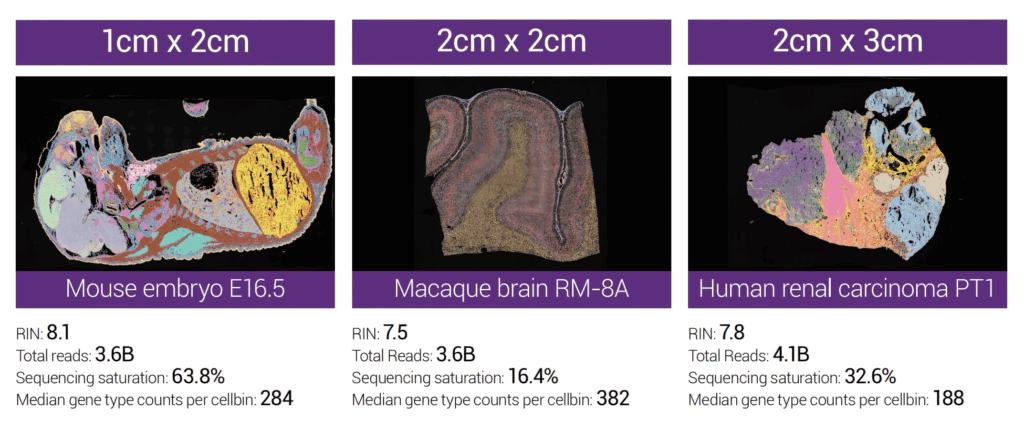
中文 Most spatial transcriptomics platforms today are
limited by their small capture areas, often insufficient
for whole-organ analysis, study of developmental biology,
or mapping disease progression across large tissue
sections. To overcome this, STOmics upgrades its
Stereo-seq Large Chip Designs, enabling ultra-wide
field-of-view spatial profiling without compromising resolution.
✔ Ultra-high Resolution: With a resolution of 500nm, it presents the molecular landscape at the spatial micro-scale.
✔ Ultra-large Field of View: The detection area in a single experiment is large, with a maximum size of 13 cm x 13 cm.
✔ Spatial Single-cell Analysis: It enables unbiased whole-transcriptome capture and supports Cellbin to achieve spatial single-cells in the true sense.
✔ Support for Customized Sizes: The chip size can be flexibly customized according to the size of the research tissue.
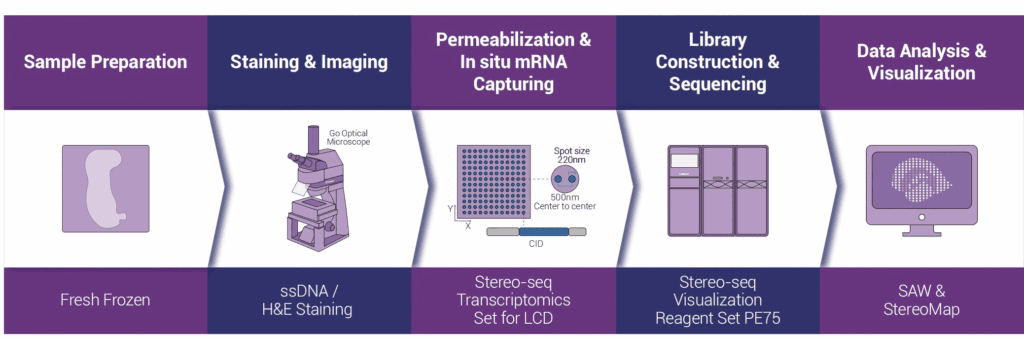
✔ High Compatibility: It is compatible with all species, fresh-frozen samples, and allows for SSDNA/H&E staining on the same slice.
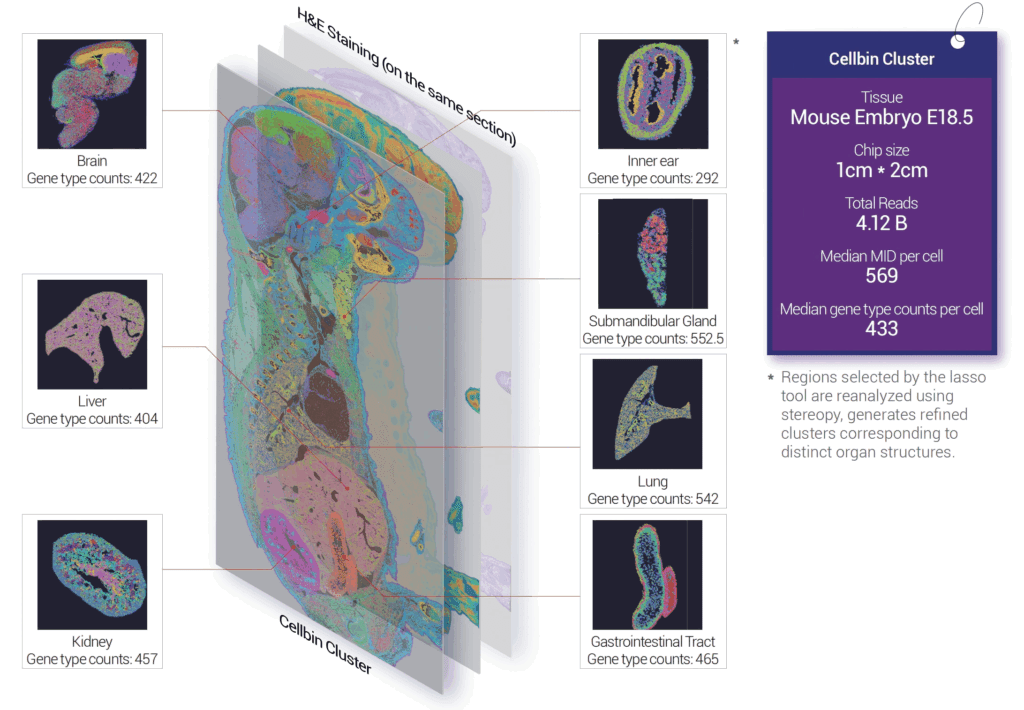
Unlock Multi-Organ Insights within a Single Section with Stereo-seq Large Chip Designs
Stereo-seq Large Chip Design Solution enables the simultaneous detection of multiple organs within a single
section, as well as precisely identifying different cell types within individual organ.
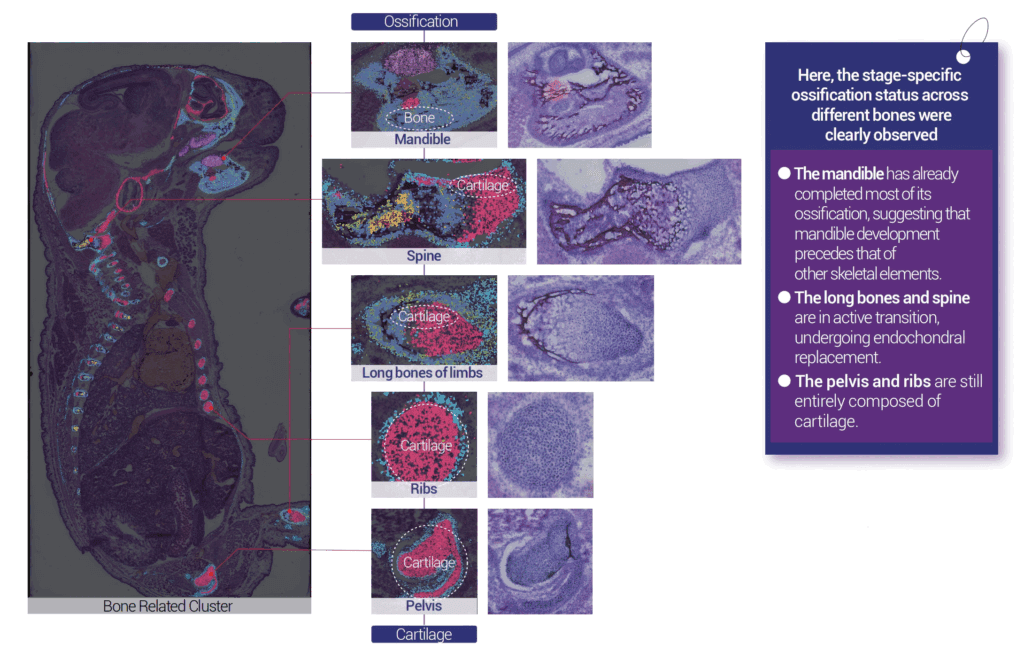
High fidelity spatial profiling of stage-specific ossification across skeletal structures
The mandible, spine, ribs, pelvis, and long bones in the mouse embryo primarily undergo endochondral
ossification, which is also the fundamental process underlying fracture healing. In this process, chondrocytes first
proliferate, enlarge (hypertrophy), and eventually undergo apoptosis, after which they are replaced by bone tissue.