RXBio Translates Sequence to Science and Industry

 中文
中文Widely targeted metabolomics technology, a new type of metabolomics detection technology that integrates the advantages of the “extensiveness” of non-targeted metabolomics and the “accuracy” of targeted metabolomics, enables the qualitative and quantitative detection of more than 2,500 functional metabolites in biological samples at one time.
✔ High throughput: Qualitatively and quantitatively detect more than 700 metabolites in biological samples at one time, discover more compounds and find biomarkers more easily.
✔ High sensitivity: The lower limit of detection reaches the picogram level. It can discover more substances with low abundance and screen out biomarkers that were not found in previous studies.
✔ Accurate quantification: The AB 6500+ triple quadrupole is the gold standard for quantification. It can accurately screen biomarkers. In combined multi-omics analysis, the correlation analysis is accurate and reliable.
✔ Accurate identification: A self-built MWDB medical standard product database has been established. It is beneficial for data analysis, saves costs and there is no need to purchase standard products to confirm the identification results.
✔ Wide coverage: It covers more than 95% of the pathways in KEGG. Combined with KEGG pathways, functional research becomes easier.
✔ Newborn screening
✔ Individualized treatment
✔ Biomarker screening
✔ Disease diagnosis
✔ Nutritional assessment
✔ Research on traditional Chinese medicine
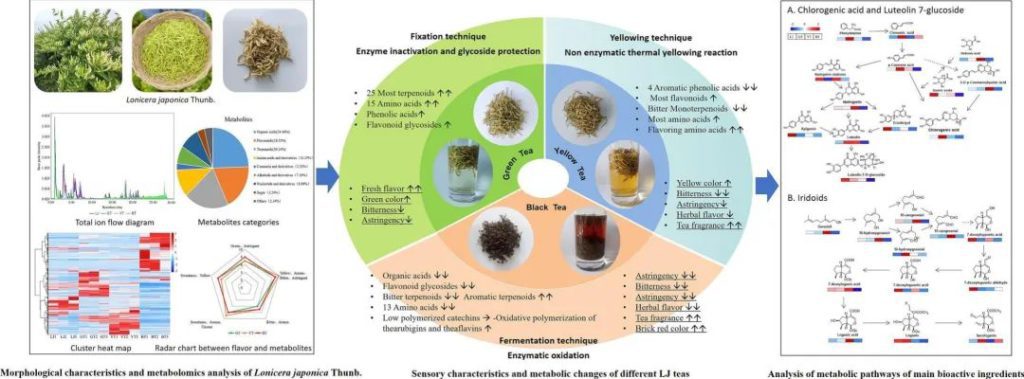
Title: Widely targeted metabolomics bridges the sensory characteristics and bioactive components of three typical Lonicera japonica flower tea.
Journal: Food Chemistry (Impact Factor = 8.5)
Publication Date: March 2025
DOI: 10.1016/j.foodchem.2025.144009
Lonicera japonica (LJ) tea has unique flavor and health benefits, which stem from the homology of food and medicine. However, their material basis and flavor characteristics remain unclear, so three typical types of tea were selected for exploration. Based on metabolomics, 557 metabolites of 9 types were identified, among which organic acids, flavonoids and terpenoids were the main contributors. Specifically, black tea had the darkest color and the weakest bitterness, followed by yellow tea and green tea. Organic acids, including phenolic acids such as chlorogenic acid, were positively correlated with the fresh green color and bitterness. Flavonoid glycosides such as luteolin 7-glucoside were significantly positively correlated with astringency. Most importantly, as the unique bioactive components in LJ, iridoids contributed to its unique flavor and could be regarded as important quality indicators. The research results provided theoretical basis and technical support for the quality control and process optimization of LJ tea.